Saturday, March 24, 2012

VO2 Max Test Results

Friday, I finally connected with the famous Dr. Will Peveler from Northern Kentucky University. He is a cycling expert and director of NKU's Human Performance Laboratory. He has been busy researching pacing strategies through extensive testing of competitive cyclists/triathletes. Locals are happy to volunteer to be his lab rats, since it means an opportunity for a free VO2 Max test, which can normally cost a couple hundred buck$.
Dr. Will is Dr. Evil. But he's really nice.
To prepare for the VO2 test, I took Thursday off from workouts. I woke up at 6 am and ate ~500 calories of dates and about a liter of water. When I got to the lab, it looked like one part Nerd-Jock-Heaven and one part Pit of Despair. Dr. Will took my height, weight, percent body fat and a general health questionnaire.


Dr. Will set me up with a relatively comfy fit despite the fact that the bike kinda looked like it once belonged to Jerry Seinfeld's dad. But this is the option if you only bring your SPD cleats.

Then Dr. Will puts the face mask on you. There are other VO2 tests which don't require a mask, but do require taking blood. Regarding the blood-draw method, Dr. Will said, "The inflection point is harder to find." I didn't slow the fast-talking doctor down to ask what he meant (or to insist on a blood draw), but I think you'll see what he means when we look at my results.
Special valves in the mask allow fresh air to come in from the right/white tube my exhaled CO2 to go out the left/clear tube, where it gets analyzed by the computer.  The mask if VERY hard to break in.
Darth Vader's mask is also hard to breath in. But for Darth Junior and a VO2 max test... you can't NOT ride with the mask.
Once I had the mask firmly on my face, I had to pedal the bike above 90 revolutions per minute for the duration of the test. Every two minutes, Dr. Will would add an increment of resistance. Through the feedback of my heart rate monitor and the breathing monitor, he was able to push me and push me until I reached failure. So, it was I who decided when the test was over.

I had mentally prepared to embrace the pain cave all week, but failure is never an easy place to go, even if we do it several times per week in Spinning. I lasted about 15 minutes before I tapped out. Maybe I could have gone more, but in addition to the effort being extremely hard, having the mask restrict my breathing made me feel claustrophobic and panicky-- a bit too far beyond my "comfort zone" of normal excruciating pain.

Dr. Will gave me a two page print-out of a table of numbers, which is difficult to make sense of. But once I put them in graphical form, it's a bit more intuitive to see what's going on and it seems to match what I saw Dr. Will looking at on his computer monitor. 


RESULTS
The red line is where I blew up and terminated the test. The intersection of the red line and purple line (VO2/kg) is the ultimate goal of what we are looking for-- VO2 MAX. In other words, what is the largest volume of oxygen my body can breathe in and make use of to burn its fuel in my cells. It was 68.7 ml/kg/min (or 4.78 L/min). At this point of maximum effort, my cycling heart rate is 189 beats per minute. Note that your maximum heart rate is not usually equivalent across sports and it's a physiological feature that many experts say cannot be changed. Your max is your max. It's not bad. It's not good. It just is. But my VO2 max value of 68.7 ml/kg/min definitely can be changed. It's my goal to bump it up.

OTHER STUFF
As you can see, my heart rate is indicated in orange and increases as Dr. Will adds resistance and as time passes (horizontal axis). The green line has something to do with my "ventilation" rate. It stays pretty much parallel with my heart rate until it reaches the aqua line-- my "Threshold". At this point, ventilation and heart rate de-couple. This is what Dr. Will meant by "inflection point". It is the super-critical point, called The Lactate Threshold (or Anaerobic Threshold), beyond which lactate is produced in the muscles faster than it can be removed. This is where your exercise activity crosses over from being primarily aerobic to primarily anaerobic. So, 171 beats per minute is my threshold heart rate. This completely agrees with my suspicion from low-tech DIY thresholds tests at Spinning class. It is also the heart rate I tend to average for a 40k time trial. Cycling guru, Joe Friel, refers to this pace as your Critical Power 60 (CR60)-- as in, this is the maximum power you can sustain for 60 minutes. He also calls it Functional Threshold Power (FTP).

Dr. Will said the highest VO2 max he had ever tested on someone was 79-80 ml/kg/min. He also said that a sedentary college aged male measures at about 35 ml/kg/min. Cross country skiers are famous for having VO2 max's in the 90s ml/kg/min! But what does it all mean? How can I get faster?

The most important outcome for me for this experiment was to find my threshold. This has far more relevance to my race pace than VO2 max. In fact, maximum power is not the determining factor of race victories; rather, your efficiency at sub-max levels is more predictive of endurance race success.

The secret to improving your race pace is to train just below, at, around, about your lactate threshold. With smarter training through the season, bigger efforts should be perceived as more manageable and sustainable. At this point in the spring season, 171 bpm is 89% of my max heart rate. As the season progresses, I might be able to race for one hour at 95% of my max heart rate.

FYI
While searching some cycling forums, I found that world class pro rider Ivan Basso achieved the following results on his VO2 Max test:

VO2 Max Test

VO2 5.760 L/min
VCO2 6.458 L/min
VO2/kg 83.5 mL/kg/min
VCO2/kg 93.6 mL/kg/min
VE(BTPS) 215.8 L/min
Max HR: 196
Max Power: 490 Watts
Max Power to weight ratio: 7.1 Watt/kg

Ananerobic Threshold
VO2 4.680 L/min
VCO2 4.824 L/min
VO2/kg 67.8 mL/kg/min
VCO2/kg 69.9 mL/kg/min
VE(BTPS) 129.1 L/min
AT HR: 175
AT Power: 380 Watts
FTP power to weight ratio: 5.5 Watt/kg

These are the numbers it takes to win the Giro d'Italia!
Real men wear pink (in Italy especially).
As the season progresses, I plan to get tested again and we'll see how the numbers change.

Thursday, March 22, 2012

Highlights for Kids

In a short stretch of just three mile along my ride to work, I can play a real life game of Highlights for Kids with the city's bike lane signage. Spot the Difference!

I try to come up with unique names for all the different personalities that show up.

Squatty Floating Mushroom Head (AKA Dwyer's Grotesque Shoulder)
Chevron Ghost Rider

Elongated Mushroom Head Mime

Virgin and Child

Layin' it on Thick

Shin-Splitter Squatty Mushroom Head

If you've read the book Switch by Chip and Dan Heath, then this week's bike adventure is begging you to ask an obvious question. If we let the City of Cincinnati know that they are using six different standards for marking roads, will that save them $1,000,000,000 in system inefficiencies? If that's the case, then I vote to use the savings to make sure that each bike commuter in the city gets to have one of the road markings painted in their image. And mine is going to be like this guy's.

Sunday, March 11, 2012

53 Miles per Burrito and My Two Moms

Let's talk about yields-- squeezing a buffulo out of a nickel, blood out of a turnip, or milk out of grass. Wait...what? That's right-- getting something from "nothing". But first, let's talk about getting nothing from everything.

Nothing from Everything
It takes a cow in Ohio about 2 hours of "work" to eat 9 lbs of dry grass. Then, through the magic of metabolism in a four-chambered gut, 1 gallon of non-chocolate milk can come vaccumed out of her wriggly teat, ready to drink, if you're a raw milk drinker. My lovely biological mom, Mother #1 (God bless her), loves the stuff.

Assuming her 20 mile round trip to pick up one gallon of raw milk takes place in an average two ton car, getting 20 miles per gallon, she probably pays less for the gas than she does for the milk even though the oil is pumped from miles beneath the earth/ocean, refined, and possibly shipped from a combat zone half-way around the world. (Only 7% of oil comes from a "free" country, says Freedom House).

It took about 200,000 lbs of ancient plants and millions of years of horrible conversion rates and geologic abracadabra to get just 1 gallon of oil. That's equivalent to 40 acres of harvested wheat, roots, and stalks to drive just one 20 mile round-trip to the milk co-op. 98 tons of plants per gallon! It isn't exactly nothing from everything, but it's pretty close.

Something from Nothing
My wife's lovely burrito-loving mother, Mother #2, gifted me the sticker version of the famous T-shirt below. By now you've probably seen the "53 Miles per Burrito" T-shirt (or the back of one) worn by cycling-enthusiasts.

Have you ever asked yourself, What does it all mean?

For the sake of peer review, here are some of my own rough calculations:
If I ride my bike 20 miles/hour, I burn about 10 calories/minute. That comes to 1 mile/30 cal.
(By "calorie", we're talking food calories which are technically kilocalories.) I've looked up the nutrition information for the the veggie burrito bowl I typically order at Chipotle and it comes to ~600 calories, depending on the heftiness of that guacamole scoop, which I hope is quite hefty. So the mileage I would get out of my $6.25 burrito bowl is about 20 miles' worth. That's almost the price of two gallons of gas. Worth it? You bet! When you consider the benefits and enjoyment of riding the bike you don't even need to factor in all the externalized costs of oil (i.e. environmental degradation, war, sickness, traffic jams) that don't get paid at the pump.

Of course, one could go farther than 20 miles on one burrito if they were to ride slower than 20 miles/hr. This is because of the force of wind resistance quadruples even if speed merely doubles. Furthermore, most people's non-Taco-Bellian burritos are quite a bit bulkier than mine-- overflowing with the calorie-dense extras that I don't get-- meat, cheese, and sour cream. When the burritos get in the 1000 calorie range, then you have no choice but to ride quite a bit slower than 20 mph, thus improving your efficiency. So, 53 mpg is realistic...depending on fitness level, body shape, bycicle type, weight, etc, etc, etc, etc.

Fun food math
Big ass burrito: $6.95 for 1000 calories = 153 cal/$.
Big Hamburger at McWhatshisname's:  $3.79 for 540 calories = 142 cal/$.
8 banana smoothie (2 lbs): $1.00 for 800 calories = 800 cal/$.
3 cantaloupe smoothie: $6.00 for 900 calories = 150 cal/$

Not only does the banana win the calorie per $ value meal championship, but even when shipped by fossil fuel-powered boat, it's carbon footprint is still tiny compared to almost all foods, except maybe the dandelion greens from my back yard.
A dandee-lion! Must be the last one of the season. -Sid

Saturday, March 3, 2012

Connections are Capital

The best things in life aren't things. Relationships, for one, kick ass, and I don't just mean romantic ones. Recently, I've become spellbound by the nature of RELATIONSHIPS and their overlooked power.
Hydration is half the battle.

Hydration really is half the battle.
Tough Mudder for ants

Tough Mudder for humans
I have no idea where I'm going. You have no idea where you're going. But TOGETHER, we pretty much know which way to go.

Why won't we take the honey and give the royal jelly to this girl and make her have all the babies.
Flying V-- nature
Flying V-- cinema (Mighty Ducks)
The Stadium Wave-- even impersonal relationships can make amazing things happen.

Calorie for calorie, Joule for Joule, a peloton is the most efficient form of locomotion on the Planet!
The rider in front of this pace line is doing the most work. Everyone behind him is riding at the same speed but using about 30% less effort.
Slightly more complicated than the traditional pace line above is the group cycling tactic known as the Belgian Wheel. Instead of one pace line, there are two-- a fast line on the right and a slower line on the left. Each person's turn at the front of the right pace line is super-fast. Then that person peels off to the left, catching a break, and gradually folds back into the right pace line. See my diagram of the Belgian Wheel below. (I'm sorry if my use of Mexicans offends you. It's the only way I can draw a human from above).

The Belgian Wheel is kind of like a social structure known as a Rotating Credit Association. The concept is basically a potluck dinner club, where each person takes turn hosting the potluck and everyone brings a dish.

Among nineteenth century farmers, it took the form of a good ol' fashioned barn raising. Every first Saturday of the month, for instance, neighbors would take turns helping someone in the group build their barn. This same method is often used by immigrants to America for helping launch entrepreneurial ventures, where traditional lending sources don't step up to the plate. But the act is more than merely a step around the banking system. The greater benefits are the social ties that ensue and the cross-pollination of skill sets and knowledge. The community is better than it would be if the goal were achieved through traditional usury. (O whoops, did I say usury? I'm guess I'm still bitter about the terms of my first business loan).

Neighbors, family, and friends can and should use the Rotating Credit Association for other projects as well. In fact, my brothers and I are using it for all sorts of projects-- from insulating houses to building fences, to excavating random manly stuff we've dreamed of excavating. A derivative of the Rotating Credit Association is even written into the City of Cincinnati's Climate Action Plan, as a strategy to reduce green house gas emissions and help citizens reduce their energy usage through home energy performance upgrades. We'll have to see if we can force that issue a little more this year.

Sunday, February 12, 2012

OMG! It's Ol' Man Winter

I know this winter in Cincinnati has been a breeze compared to most, but I have to celebrate victories where I can get them, right? So, congratulations to myself-- I went up 2-0 on Ol’ Man Winter (OMW) this week (the coldest week yet) and I’m just getting started!

Rather than let myself get brutalized and victimized, as I normally would, by his sneaky, creaky, cold, dark, depressing ways, I decided to change my tactics from surviving to THRIVING.

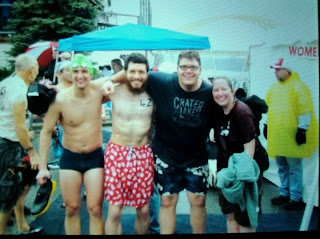
Step 1- sign up for and win a polar swim (aka- attack the left testicle of OMW)
"Swimmers, take your mark..."

GO!


Holy holy!

Stay loose. It's not that bad.

Freezin' for a Reason: "Team Ice Men" helped to raise over $100,000 for Special Olympics this year. 

Step 2- Ride my bike to work no matter how cold it gets (aka—attack the right testicle of OMW). 

As cold as it was this week, I'm still over-heating most of my body parts, man-funking up the office with sweat. While my torso gets cooked, I'm nevertheless freezing a couple of vital body parts. Sure, these can be addressed with boring old gloves, headband, booties, and padded shorts but that's just what OMW wants you to do. And who has time to remember all those things and look for them when they inevitably get scattered around the basement?

For this reason, I've invented a new line of cold weather cycling gear that melds the highest functionality of some classic wardrobe staples (mitten clips, mankini, bib shorts, ear muffs, footie pajamas, and speed suit, into a single article that serves ALL winter cycling needs. I call it "The Chri-Smitten".
The Chri-Smitten


Step 3, as I’ve mentioned before, involves building toward a 6 mile barefoot run in the snow. Unfortunately, we haven’t had any accumulation this winter, so I’m stuck running the boring old fully-clothed way. Fully-clothed running is exactly what feeds OMW his arrogance and power and we all need to try to do as little of that as possible.

I’ve been ramping up mileage in my Vibrams, but the pavement is a mother on my Achilles tendons. So, I start out in my regular shoes, with my Vibrams stuffed in my Camelbak. At the first sign of inflammation in my toe, I swap my shoes and socks for the Vibrams and run with my shoes over my hands like mittens. (OMW hates clever non-traditional cold tolerance strategies like this).
The Brooks running shoes are great mitten-substitutes. The Camelbak holds my water, snacks, and Vibrams for emergencies.

My distance is maxed out at 6 miles but I’ve been doing speed work on the treadmill and that has blistered-up my dogs quite nice. Soon, I’ll have badass calluses growing all over my supple diva feet. If we get no accumulation this year, I promise to get my 6 mile barefoot run in before winter’s end. This would essentially smash OMW’s testicles together into one amorphous snowball.

Surviving winter, for me, has always entailed some essential coping mechanisms—all good and helpful in their own right, but pretty much the bare minimum to skate by between New Year’s and St. Patty’s Day. Here they are in order of their importance to me:

Carbs
I’ve always found that if my body felt cold then I was either under-dressed or under-carbed. I aim for about 5 grams of carbohydrates per pound of body weight daily—That’s about 3000 calories of carbs per day, unless I’m doing a lot of training, then I have to eat up to twice that. My preferred carbs are fruit, the second option-- potatoes, third best-- rice, and fourth best being pasta or breads. I notice my head gets cloudier at work as I move toward those fourth tier options, though.

Layers
I have no shame in wearing long johns under my work pants. If you saw me on the street, sometimes I'm so layered I look like I've got the body of a linebacker but with an inappropriately small head. Don't be fooled-- I just love to layer**. When I'm over-dressed, my runs actually happen. Setting up the conditions for an outdoor adventure is more important than actually getting outside.

**This may seem like a contradiction--feeding OMW's power, but actually that only applies to the outermost layer. If my outermost layer is just a spring jacket (and I have three layers beneath), that's far superior to one poofy winter jacket. You can always shed layers if you overheat. Plus, you can't run through the woods if you're dressed like the stay-puff marshmallow man.

Sun
Maybe it's the Vitamin D, maybe it's the ultra-wide spectrum of light stimulating the eyeballs, maybe it's the beauty of nature, maybe the connection to a wider solar system...The sun is freakin' sweet medicine for me!

St. John’s Wort
His is by far my favorite wort. Whoever St. John was as a person, I’m a proponent of his wort’s magical powers.  It’s not that SJW gets me high, or anything close, but it really smoothes out the divots. It’s like rollerblading on newly paved blacktop versus a crusty sidewalk. I haven’t felt the need to take it for the last two years, but it's not like I've joined 12-step program to get over it.

"GTHOOD"
If all else fails, you can always "get the hell out of dodge". A mid-winter trip to a warm, sunny beach might break the bank for most people, but a cold, mid-western tedium might break the person.

I went on a mission trip in the Bahamas one year, which wasn't that expensive (or plush) at all, but it carried physical and spiritual therapy for me. As I write this, I'm thinking how ridiculous it is that some version of this isn't one of my yearly traditions. I'll have to work on that. I'd love ideas, too, if you have them.


Friday, January 27, 2012

Middle Toe is Asking Me to Free Willy

My physical therapist, Eric, made me take two weeks off from running, suggested I buy new running shoes, and put me on a multi-vitamin for dudes. Yuck to the first, cha-ching to the second, and "Lordy, my pee is neon," to the third.

So, at the stroke of the fortnight, I hit the tarmac pretty hard last week, logging 35 miles in my brand new shoes. It was bliss to finally get off the stair-climber and move through actual space with not one smidgen of pain in my toe. Then, today happened.
 
I was out for one of my favorite neighborhood loops. About four miles in and in a matter of three seconds, my middle toe got reallly hot and then the next instant it was pulsating with lightning bolts of black magic torture. I dropped to the ground, took off my shoe and sock and started the ol' deep tissue foot massage. Sometimes this works like a charm, but when I got back up to continue on my merry way, the toe hissed back, "No deal!"

For some bizarre reason, when I'm walking in my shoes, my toe continues to twinge. But when I walk or run barefoot or in my Vibrams, there is no issue whatsoever. So, there I was, about 4 miles from home, having to either walk in the cold with an annoying toe-twinge, but well dressed in my cool new shoes, or... run lopsided on the hard, damp, muddy, pavement with only one shoe like some kind of Quasimodo. It goes without saying, which one I chose. And the weird thing is, I was totally stoked that it would be great practice for my overly-hyped first annual barefoot snow run that still hasn't happened due to this winter's snow drought. 
My sock was a life-saving technology today.

My sock is dead. But this man will live to tell another tale.


It's a mother-fracker on my achilles doing any distance in the Vibrams. I'll really have to work my way up to it gradually since there are only 16 weeks until the year's first big race-- Triple T. I think I'll have to use the injury as an opportunity to adopt a more stair-based training regimen while I slowly transition to becoming a barefoot runner.

Also, on the topic of unnecessary exposure to cold, I have a cool opportunity to do a polar plunge for Special Olympics next weekend. My goal is to raise another $999,999,975 by next Saturday, February 4. Any it$y bit$y amount helps, if that's your thang. Or if you need to cool off from this winter heat, come on out!! Click the link to donate and get into heaven free.


Sunday, January 8, 2012

Bowling Alone

Have you ever read an absolutely amazing story by Cliff Notes, then felt inspired to read the full length 600 page version only to find the story's potency diluted by all the boring details and your short attention span? We all have. I just read an amazing, but not very readable book, called Bowling Alone: The Collapse and Revival of American Community, by Harvard Professor of Public Policy Robert D. Putnam. The story is powerful but the book was painful. And for the reason above, I don't recommend it-- just finish reading this blog post. So let me try to curdle out the gist, warp the context, and then make it apply whatever I felt like applying to my life these days.

Bowling is the number one sport in which Americans participate. But people don't join bowling leagues like they used to. Instead, they bowl alone. And they save cash by not buying beer and pizza. They're in; they're out. And it is precisely the beer and pizza sales that keeps the bowling alley in business. So, bowling alleys are forced to close down and thus, fewer people will be joining bowling leagues...and believe it or not, societal team morale weakens.

Since the 1960's, participation in community life in America has been tanking! With a few exceptions, most community activities and organizations, formal and informal, follow a harrowing trend that looks like this:


It's hard to read the graphs but the point is they mostly trend downward when the book was written.
Putnam argues convincingly that the social ties established, from Euchre clubs and PTA meetings to bowling leagues and wine tastings, is essential to America's sense of reciprocity, trust, optimism, democracy, equality, and even physical health. The networks of relationships formed are both bonding and bridging-- essential to democracy's proverbial glue and WD-40.

I've tended to resonate with Putnam's chapters related to health and well-being. Consider the following excerpts:

"The single most common finding from a half century's research on the correlates of life satisfaction, not only in the United States but around the world, is that happiness is best predicted by the breath and depth of one's social connections."

"In study after study people themselves report that good relationships with family members, fiends, or romantic partners-- fare more than money or fame-- are prerequisites for their happiness."

"Dozens of painstaking studies from Alameda (California) to Tecumseh (Michigan) have established beyond resonable doubt that social connectedness is one of the most powerful determinants of our well-being. The more integraded we are with our community, the less likely we are to experience colds, heart attackes, strokes, cancer, depression, and premature death of all sorts."


"The positive contributions to health made by social integration and social support rival in strength the detrimental contributions of well-established biomedical risk factors like cigarette smoking, obesity, elevated blood pressure, and physical inactivity."


"People who are socially disconnected are between two and five times more likelly to die from all causes, compared with matched individuals who have close ties with family, friends, and community."


"By many objective measures, including life expectancy, Americans are healthier than ever before, but these self-reports indicate that we are feeling worse. These self-reports are in turn closely linked to social connectedness, in the sense that it is precisely less connected Americans who are feeling worse."


"Generally speaking, as one rises up the income hierarchy, life contentment increases. So money can buy happiness after all. But not as much as marriage...In round numbers, getting married is the 'happiness equivalent' of quadrupling your annual income... Four additional years of education-- attending college for example-- is the 'happiness equivalent' of roughly doubling your annual income...Regular club attendance, volunteering, entertaining, or church attendance is the happiness equivalent of getting a college degree or more than doubling your income. Civic connections rival marriage and affluence as predictors of life happiness."


"If one wanted to improve one's health, moving to a high-social capital state would do almost as much good as quitting smoking."

Some days, we wake up with tremendous drive to save the planet, raise a family, or close a deal. Other days we feel crippled, solitary, and weak. I know I can't save the planet. But Putnam has really helped convinced me that we can bowl our butts off as if we're saving a country and that's almost as important.

Now, bowling is not my sport, but I feel like I've bridged and bonded over the years with more people than previous years by taking up cycling and triathlon-- one sport whose participation levels are rapidly rising.

The most efficient form of transportation on planet Earth (and an awesome rush) is a cycling peleton, especially with big black dudes...except when it's lost.
Riding the mountains of Townsend, TN in the spring with the Major Taylors cycling club. Major Taylor was the first African-American world champion (cyclist). There are Major Taylor cycling clubs all across America. You don't have to be black, but white people don't look as good in jazzy colors.
Putnam tells a cool story that I'm just going to cut and paste right out of his book to conclude:
Before October 29, 1997, John Lambert and Andy Boschma knew each other only through their local bowling league at the Ypsi-Arbor Lanes in Ypsilanti, Michigan. Lambert, a sixty-four-year-old retired employee of the University of Michigan hospital, had been on a kidney transplant waiting list for three years when Boschma, a thirty-three-year-old accountant, learned casually of Lambert's need and unexpectedly approached him to offer to donate one of his own kidneys. "Andy saw something in me that others didn't", said Lambert. "When we were in the hospital Andy said to me, 'John, I really like you and have a lot respect for you. I wouldn't hesitate to do this all over again.' I got choked up." Boschma returned the feeling: "I obviously feel a kinship [with Lambert]. I cared about him before, but now I'm really rooting for him." This moving story speaks for itself, but the photograph that accompanied this report in the Ann Arbor News reveals that in addition to their differences in profession and generation, Boschma is white and Lambert is African-American. That they bowled together made all the difference. In small ways like this-- and in largerways, too-- we Amercians need to reconnect with one another. That is the simple argument of this book.