Sunday, November 14, 2010

Foam-a-home-phobia

Cincinnati is a mixed climate with extreme highs in the summer and extreme low temperatures in the winter. But, since my wife and I regard AC as more of a luxury, we are not big air conditioning people. We are way more concerned about keeping warm in the winter which we can't do without spending a ton of money and feeling really guilty about all the fossil fuel energy required to do it.

The wonderful thing about a 1920's craftsman/cape cod home is the predictability of it's energy sins. Cute as they are, they are little bastard children unfit for any performance challenge. They've got lots of problems...but at least we know where to find them--everywhere!

Look at my cute home.

Oh my gosh that's cute!

If you are thinking to yourself, "It needs new windows" You need to come back to planet Earth, take my class, and wean yourself off of the marketing teat of those window companies advertising on the back of public transportation. If you've taken my class, then you know how to do my Curb-Side Energy Audit in about 30 seconds and can name 4 of the 16 architectural features of my home that need to be addressed, and CAN be addressed with some foam insulation.

I've actually formed a great friendship with a guy who has access to a new formula of cavity filling foam and is open to alternative no/low-cost transactions and bartering. SCORE!

My stick-framed walls were built with true dimensional 2x4's in the balloon-framed style, which means behind the plaster and lathe walls there are stud cavities are open to the basement and they have no insulation. (It used to be a perfect getaway route for the mice we had until our cats learned to hunt like a pack of velociraptors. Although foaming the walls has immediate sex-appeal...NOT SO FAST.

There are several ISSUES to be concerned about:
  • What do we do about existing knob and tube wiring in the wall cavities?
  • How do we trace and stop the moisture issues at the roof/chimney?
  • What is the home's Building Tightness Limit (BTL) and will we need to revise our ventilation strategy?
  • What are the indoor air quality effects of the foam to be installed?
  • Where will this foam go and could it damage anything?
  • Do we fill the stud cavities from inside the home or out?
  • What is the long term performance of this product?
I'm not quite foam-a-home phobic about these issues, but consider the following:
  • knob and tube wiring was installed in the 1920's and is rated for 20 amp circuits because it can stay cool by dissipating its heat into the air around it. Insulating the cavities however would cause it to stay hot. There is a lot of urban lore out there that says insulating the cavities with K&T wiring is a fire hazard. I haven't found a lot of available information to substantiate these claims. Electricians have told me my house will catch on fire unless I rewire. Their bids range from $4000-$8000 to rewire my house. (Fear tactics from the fox guarding the hen house?) Insulation contractors have told me they can insulate without rewiring, but they won't pull a permit. Electrical engineers have told me I can insulate the cavities around the existing K&T but I would have down grade the circuit from 20 amp to 15 amp.
  • The only thing worse than no insulation in the walls is wet insulation in the walls. Now, if this were dense-pack cellulose or even fiberglass insulation, that could be a major problem, but installing a closed cell foam, we would would hope that would be a much smaller problem. But we can hope on the one hand and $#!X in the other and see which one fills up fastest. Why hope? Let's just fix the roof first, regardless of whether this is open cell foam, closed cell foam, cellulose, soy or mushroom insulation.
  • The Building Performance Institute (BPI) would say something like, "There's no such thing as a home that's too tight. But there is such a thing as an under-ventilated home." There is a quick calculation I will show you in a later blog that lets you know when your home has become under-ventilated.
  • Insulating from the inside requires drilling holes every 16" in the plaster and filling the whole house with plaster dust. I'd drill them in the middle of the wall so I wouldn't have to climb a ladder to install the insulation or, more importantly, when I have to patch, sand, prime, color match, and paint, and paint, and paint those holes at the end. 
  • Insulating from the outside requires taking off the cedar shakes and risking breaking them, or else drilling holes in the cedar shakes and risk breaking them, definitely breaking drills bits drilling through 3/4" of pine sheathing, patching, sanding, priming, color matching, painting, and paining the entire exterior walls of the home. 
  • The long or even short term performance of foams has been mixed in many of my infrared inspections. I have seen some installations where foam was injected into stud cavities of walls only to shrink like a refrigerated waffle and leave air pockets of no insulation at all six sides of the stud cavity, making it very ineffective. I've also seen foam spray out of outlet covers and switch plates and beneath toe molding.
Even if we were swimming in money and answers and remedies to these issues, we would still NOT start our retrofit project here. Instead, AS ALWAYS, we need to start up high in the attic with air sealing.

When I say "air sealing", I don't mean what most people think. It has been my experience, in the thousands of homeowners I've visited with, that most of my clients have this bucolic image of Little Red Riding Hood skipping her way to the home improvement store and coming home with a satchel of baked bread and two or three tubes of caulk. They say, "Can't I just climb in the attic and do the air sealing myself?"

My answer is usually, "Yes, you could, It's not rocket surgery, but you need about 2-3 shopping cars full of foam and caulk (~$900 worth), and more importantly, to complete the job, you'd have to have the physical stamina to do something like the guy in the pic below, if you don't want to kill yourself, falling between the roof trusses."
The parallel bars are about as tricky to maneuver as 24"on center roof trusses when air sealing an attic. Olympic gymnasts make great insulation contractors.
Even without a gym membership, this guy is doing his exercises to become an insulation contractor. It's the most respected job in his eco-village. Everyone falls through the drywall ceiling at least once before they realize they have to spend more time on the elephant tusks training.

And don't assume that because your home was a custom-built McCastle that you don't have air sealing issues-- you're usually the worst ones of all with all your tray ceilings, built-in book cases, bulkheads, planter walls, and recessed lights.Air follows the path of least resistance, which is almost always upward through the home's cavities.

I'll keep you updated on the foam project, but FIRST AND FOREMOST:
  1. it's a roof project first because durability issues are more important than energy bills.
  2. it's a rewire project because I can't afford an electrician and I can do some electrical work. (I actually just finished the bulk of this project-- see the pics below and come to my house to see that I have not yet taken care of the chimney issues--YIKES!)
White ceramic knobs hold the black and white insulated "tubes" of the so called hot and neutral wire. They travel somewhat parallel to their load but always kept at a safe distance from each other. The yellow wire is a new 12 gauge Romex now serving their load. This circuit has been disconnected. What am I going to do with the $7,800 I just saved?
That's not good. Water damage to plaster above window. The root cause of this is very likely associated with the issues I describe in my blog"Saving the Planet by Saving Cincinnati's Obsolete Real Estate (AKA Troublesome Architectural Features)"

Saturday, November 6, 2010

Sweet Tooth Gone Wrong

For a week or two after my first Ironman, my teeth ached like they were filled with cavities. I don't even have cavities, and I've practiced good dental hygiene habits. And I don't eat junk food...except when I'm on long workout. Has anyone else has had this experience? I wondered if it had to do with what I ate during the course of the race...I'm so ashamed of what I put into my body. Here's a pic of some of the stuff I consumed during the race.
Junk food eaten during a typical training weekend two years ago. I think I see a banana somewhere in there.

Since then, I've had a couple of achy tooth days here and there, usually after long training weeks. It brought to mind some of the research my mom was telling me about Weston Price Foundation, which my mom is a devotee of. They are very much sure of themselves in a couple of theories that stick out in my mind--1) that animal products are essential to human health, 2) veganism is the worst thing you could do to your body, 3) tooth health is an indicator of overall health. As much as I didn't want to believe what Satan was saying, I'm sure there is some shade of truth to #3 here...

It begged the question, where does one go to get real answers to nutrition questions? There's so much bull shit "science" out there and so many passionate charlatan diet-ists, lobbyists, and nutrition gurus looking to make a buck, that I've decide to just unplug from that grid.

When you think about it, all we ever really do is defer to what others tell us about food and nutrition. From the ads on TV, to the way the supermarkets are stocked, to the latest mono-food diets (grapes only with a side of a cool whip, really?) and roller coaster fasts. It's kind of like letting a psychologist with a comb-over tag along on your dates. How is a passionate romance ever going to catch fire amidst the constant deluge of theories?
"Now would be the appropriate time to kiss the female."

Instead, I'm trying to develop a deeper intuition around food, so that I can recognize the meaning of my cravings and the nuances of my nourishment. My body has its own intelligence if I just trust it, but instead I get caught up in asking for other people's hints. I feel like I just need to go make-out with my smoothies for a while and see if I can't get to home base without anyone's supervision.

My produce delivery friend, Randall, who is also one of my nutrition consultants asked me what my cravings were this week. I told him, "you know, I never really liked chocolate that much, but I'm craving chocolate incessantly."

His reply was awesome: "I have one rule about chocolate-- eat as much as you're craving...as long as it's the good stuff."

What a concept! Trust our cravings...with some trepidation and healthy respect for the effects. I suppose it makes sense that our body is a "feedback" system in communication with the one who feeds it. It's not a one-way relationship.

Saturday, October 30, 2010

Biker Butt has Garlic Remedy


By the time I finished training for Ironman Louisville, 2009, I could have ridden the bike portion naked, or heck, even smuggled rusty railroad spikes across cobblestone streets on a Belgian border town. My butt had suffered hundreds of hours of saddle-time...and at great expense. The '09 season introduced me to my first ever case of hemorrhoids.

What's tougher than spelling hemmorhoids is enduring them. They didn't just hurt while riding, but they were keeping me awake with their itchiness. I remembered commercials from when I was a kid, where a cowboy would whistle for his horse and then jump spread eagle, landing his sweet man-spot right on the bridge of the horse. "Ouhhhh, my hemorrhoids are killing me." As a kid, I never even knew what they were, but I liked the commercial and I remembered the product. (Wow, the power humor in advertising.

Of course, there were some preventative measures that I neglected, like lubricants and fewer hours on the bike. If hindsight is 20/20,  then sight of my hind was hovering at 0/666. It's funny how this mostly invisible shadow of your body can move front and center to become a vanity issue.

My friend and fellow cyclist/small biz owner (massage therapist), Andrew, told me that he always got laughs at this when he would tell the Major Taylors Cycling Club, that there was an old remedy to stick a peeled garlic clove straight up the man-hole. They still give him hell for it. All I can say is that I am so proud that Andrew had the balls to ever try. He knows all kinds of natural remedies.

THE REMEDY
All I did was peel a medium sized clove, put a teeny bit of olive oil on it...and "swallow".

On the scale of discomfort, it was only slightly annoying--like the feeling of having a booger, and only for about one hour before I went to sleep. When I woke up in the morning, I felt no garlic intruder. In fact, I felt only that my hemorrhoid had subsided and was no longer itchy. When I did my daily number two later that day, there was no problem "uncorking the bottle." The garlic clove popped right out along with some really great humanure. 

I thought I had been cured once and for all. But unfortunately, all it would take is a bike ride or a long run to get the little devil to flair up again. Therefore, I had to do the garlic routine a couple of times per week whenever it bothered me.

Now that I've been focusing more on my running and re-inventing my relationship with my bike (post Susie's bike crash), I have had no problems in my nether-region. So, I try to stick to taking my garlic normally-- down the hatch rather than up.

Garlic is amazing.
Me at the zoo, with biker butt.

Sunday, October 17, 2010

Everything is Connected to Everything... and so is Food


The autumn forest is one of my favorite place-times. The smells, the colors, the peace, the crispy air- aaahhh! My dear friend Randall, (AKA the produce delivery man), and I had a beautiful hike and a great time catching up on each other's lives at the famous Ault Park. We discussed everything from conspiracy theories to soul mates. And we high-fived a lot about the power of food and its relation to consciousness. Damn, I love food!
Until my emergency vegan phone calls to Randall last year, I had only known him as more of an acquaintance in the Cincy "green scene". But I always sensed this fiery soul would play an important role in my life. I called Randall because he is a "Health Food Minister". I didn't know what that was, but I knew I needed one. 

Last Thanksgiving was the day I decided to go vegan and it felt quasi-amazing to NOT feel utterly obliterated by creamy-twice-baked-cheesy potatoes and the rest of the binge-fest otherwise known as Tofurkey Day.  Yet feeling quasi-amazing is not the same thing as AMAZING. As Randall would say, "We're not here on this planet to tread water." And yet, I felt like I was sinking on many levels. In fact, with all the training I was trying to do and the cold/dark winter I was having to endure, and the spiritual quagmire I couldn't shake, winter 2009/2010 was straight up kicking my ass. I decided I needed some consultants.

Randall owns an organic produce delivery company that has become integral to my life and mission. It's called Paradise Found and you've probably seen/heard me reference him/it before.

Food is not only essential to my training and recovery; it's essential to my communion with all beings on Earth as well as to the sun and all of the forces and energies of the Universe. Each week Paradise Found delivers to my back door a "Surprise Cooler + Juice" filled with the freshest, most local, most vibrant food in the city. The fact that its contents are a surprise keeps me on my toes in the kitchen. The surprises also connect me to the seasons, i.e. I don't get watermelon in the winter but I get a lot of squash. It feels like Christmas morning every Friday when my newly stocked cooler is sitting on the back porch.

I make it my mission to let none of the fruits and veggies go to waste. Everything seems to find its way into a big-ass chopped salad or a rainbow or muck-colored smoothie. I still don't know what to do with the edible flower kits. Sometimes I gag when I eat them, sometimes they burn my tongue off, but I'm letting my body try it ALL. That's because one of the things Randall is helping me to do is to see foods for more than their tasty pleasurefullness. My body has cravings for feelings as well as flavors and the body can communicate what it needs. So, I'm learning to hear my body's cravings and I'm learning to gain a certain precognition of the subtle feelings that certain foods will leave me.

I still haven't mastered the logistics or will power required to swing this raw food lifestyle 100%, but I have to say that it is starting to feel friggin' AMAZING-- like my body is always on a vacation. According to Randall, my body is likely maintaining some of its defense mechanisms to see if I'm fo' real with this. Occasionally I'll have a leftover #$%# or a %#$$%# and my forgiving body will try to make use of that, but has to do so cautiously. I'd rather my body have an opportunity to slough off its defenses, be able to trust me to feed it the good stuff and I hope there is a continued gain in my physical and mental performance. Accelerated thinking and accelerated racing, baby! The sky is the limit.

Randall, if you're reading this, THANK YOU for doing what you do and for sponsoring me and this crazy project.

Tuesday, October 12, 2010

Vacation/Training Camp Re-Cap

I don't know that Bush hogging is, but I'm pretty sure we don't have it in Cincy.

Last week was a glorious training week/detox/relax/vacation spent on the beach in beautiful South Carolina with my lovely wife, Susie and another couple that are dear friends, Anastasia and Todd.
Back to the Beach, SC

I was so excited to enjoy some well needed rejuvenation in the form of lots of sleep, lots of succulent fresh food, some PDA with our friends' VitaMix blender, some PDA with my wife, beach bumming time, and some long beach runs.

The 12 hr car ride on the Saturday down there was physically taxing. Food choices along the main highways are slim to none outside of Subway salads. Good thing I packed lots of apples, mixed nuts, bananas, and dates. Still, that's a lot of sugary food for a guy who usually craves salty snacks. I caved in and bought some pretzels that my wife really likes and some salsa I had canned with my bro-in-law. Could it really be true that America craves beef jerkey/fireworks outlet stores more than living delicious food? I certainly see perks to living in an urban center like Cincinnati. We really do have it pretty good when it comes to healthy food options.

By Sunday morning, my body felt uncaged and ready to rock and roll!
Half-naked running means little room for snacks. Phew, I'm tired!

WORKOUTS
Sunday- 14 mile beach run; 80% AVG HR; ~110 minutes
Monday- 6 mile light run (no HR monitor), body surfing and beach bumming all day
Tuesday- 12 mile beach run; 85% AV HR, ~95 minutes
Wednesday- Daytrip to Savannah in thunderstorm
Thursday- 9 mile beach run; easy pace (no HR monitor), mixed with 10 x ~100 yard sprints + ~100 yard walks
Friday- 4 mile easy run+ Pilates led by Susie
Saturday- 12 hr return car ride home-- gross!

The raw diet was about 75% in full effect this week, which was better than I had guessed it could be while living with "others" outside of the familiar kitchen home. It was so easy using the VitaMix for breakfast and second breakfast smoothies. However, it was also easy because our friend Anastasia's health is gravely dependent on eating very clean, very fresh, very vegan, as she recovers from years of Adrenal Fatigue. She believes her condition has been caused by about 15 years of self-induced stress from school/work, Dr. Peppers for breakfast, among other personal reasons. You'd never know it, but less than a year ago, this beautiful 29 year old was being pushed around in a wheel chair! She still has a long way to go, but she's doing amazing! She runs, does Spinning, Pilates, Yoga-- the works!

MEGA BREAKFAST SMOOTHIE
1/2 avacoado
1/2 C raw organic oats
1 apple
1T hemp seeds
1 banana
2 dried/pitted dates
1 small handfull of raw nuts (pecans, almonds, Brazil nuts, and/or walnuts)
~2 C of filtered water

SECOND BREAKFAST SMOOTHIE (post workout)
1 softball size fistful of spinach
1 banana
1T hemp seeds
1T chia seeds
2C almond milk

NON-RAW MEALS
this week were all cooked in our own kitchen and prepared with TLC. They included the following:
1) Blackbeans and veggies with rice
2) Curried veggies with rice noodles
3) Lentils
4) Fall harvest Quinoa-stuffed acorn squash

OTHER RAW MEALS included
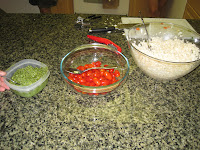
1) Cilantro brazilian nut pesto with jicama "rice" and tomatoes
2) Kale, carrot, cabbage, ginger, garlic, apple, nut, salad-palooza-mamma-jamma!
Killer Kale Salad will put hair on your chest and chase vampires away. It's simply amazing!
Todd's Quinoa-stuffed squash will caress the autumn cockels of your heart. In the winter, my feet get very cold and squash makes them feel better.
Curried veggies and potatoes. All ingredients came from my kick-ass produce delivery man at Paradise Found in Cincinnati.
Cilantro-pumkin seed-brazilian nut pesto with tomatoes and jicama "rice"
Goodbye South Carolina!

Monday, October 11, 2010

Saving the Planet by Saving Cincinnati's Obsolete Real Estate (AKA Troublesome Architectural Features)

Dormer on second story
If you have a dormer on your home, then you're likely to have a room with strange walls that look something like this:
Kneewall
...and you have energy problems.  Behind the short walls, called kneewalls, folks like to store stuff like Christmas decorations and old Legos. They sometimes call it a “crawlspace”, but it would be more appropriately called an “icicle maker” in most of the homes I visit.


Why are these rooms so problematic? And what can you do about it?

Rooms that have this feature are normally the least comfortable room in the house, and reserved for in-laws or teenagers. It’s often called a “bonus” room when it sits above the garage. But in actuality, it acts more like “penalty box” in an ice skating rink than any kind of bonus. These rooms are a major source of energy loss because of how they are constructed and connected to other parts of the home. They can also end up causing a lot of ice/water damage to the roof and walls below, too. 

 If we were to add up all the square footage of rooms like this in the city of Cincinnati, we’d get an enormous real estate footprint. Of course, I don’t have the statistics on this, but for the sake of argument, let’s make something up--

Assume the following:
150,000 (homes in Cincinnati)  x 10% (have a bonus room) x 150 sq ft (average bonus room  size) x $50/sf (real estate value in this market) = $112,500,000.00

That’s a LOT of obsolete real estate that was bought but is not being enjoyed. On the contrary, there is a hefty monthly utility expense to keep it only quasi-comfortable, and on top of that there is the environmental impact of the pollution and CO2 and the degradation caused to the roof and gutters from ice dams.

How would you like it if you bought a home new home that was advertised as “3 bedroom 2 bath, in nice school district, granite countertops”, but the first cold day started acting like a “2 bedroom, 2 bath, with a frozen pond on the roof”? It would have to be a really nice school district to compensate, where the students learn all about DIY home energy retrofits. 

I have an idea—give these rooms to me. Actually, you can’t even give them away—they belong more to Mother Nature that to you. They also belong more to the utility company than they do to you.
The issue is here, behind the walls and under the floor. 
Here's where your energy saving opportunities lie

There are two types of kneewall cavities—ones above conditioned living spaces vs. ones above unconditioned spaces (i.e. garage). Whichever kind of kneewall you have, the problem is usually a combination of the following:
1)    cold floors
2)      drafts in other parts of the house
3)      lots of spiders or other critters running amok
4)      freezing pipes
5)      ice dams
6) icicles
7) condensation beneath roof or water marks on inside walls
8)      high energy bills

The solution is simple but not always easy.
  
Solution1—For the situation where the room is above conditioned space(s):
Prerequisite: (if there are floor boards like the pic above, stop storing so much stuff you don’t need, give it to the Salvation Army, take out the floorboards and then build a compost or Adirondak chair out of the wood).
1)      Jam a tightly rolled-up encapsulated fiberglass insulation batt in each of the floor joist cavities directly beneath the kneewall,
2)      Then spray the floor with a ½” of closed cell foam insulation from an kit you can buy online.
3)      Then install a sheet of housewrap (like Tyvek) on the backside of the kneewall, tacking it up with special “wrap cap nails” (not staples). This will act like a net to hold back blown cellulose insulation.
4)      Rent the insulation machine and blow cellulose behind the housewrap “net” and then all over the floor. The Department of Energy recommends R13-R15 in the walls, which is about all you’ll be able to fit in a 2x4 wall. DOE recommends R49 above conditioned space ceilings.
If the room is above an unconditioned space (typically a garage), then whatever insulation might have once been installed in the garage ceiling beneath the room, is susceptible to gravity—aka sagging. It might as well be rolled up on the garage floor. 

Solution 2- For the situation where the room is above a garage (or another unconditioned space)
1)      Fill the entire floor joist cavities beneath the bonus room with insulation. (Densely packed cellulose blown with a long hose works well. Fiberglass batts work terribly here).
2)      Follow steps 1), 3), and 4) just like above.

When the project is finished, it should look something like this, where not only is the kneewall and kneewall cavity's floor insulated and air sealed, but the sloped ceiling(s) and walls below are also insulated:
Finished Kneewall ready for sloped ceiling and wall below to be insulated


What to do with these solar panels?

I bought three giant flat plate solar collectors (including pumps and heat exchangers) about 5 years ago for about $1500. They were second-hand jobbers reclaimed from the roof of a *nun-friend of mine here in Cincy. They are certainly worth their weight in copper and aluminum, but what good are they doing if they are merely acting like a junk-storing-table in my garage?

*Sr. Paula Gonzalez is a pioneer in not only the mid-west, but in the world. She built her own house in the 1980's using a barn that was slated to be razed on the campus of Mount Saint Joseph's College. She turned the barn into a genuine energy ass-kicker using friends' help over many weekends and $13k of money raised from garage sales of all the "junk" she collects.

Rather than hoist my panels 30 feet in the air to the top of my roof and start generating hot water for my luscious indulgences, I've been putting it off and tsk tsk-ing politicians and everyone else. We all have our solar aspirations, but how many of us actually have the whole kit in our garages? Probably only me...so it's time to get off my duff and conquer the obstacles.

OBSTACLES
*Aging roof-- needs replacing if these super-heavy panels are going to sit on top and not need maintenance. The asphalt shingles are built up to 3-layers now and are seriously suffering weatherization. It doesn't help that I haven't fixed my ice-dam problem (which is really an air sealing and insulation project-- see blog about homes with dormers and kneewall cavities).
*Hoisting-each panel is 3 ft x 13 ft and weighs about 150 lbs. Is it a matter of renting a scissor lift or a scaffold and waiting for a day with no wind?
*Plumbing-- the solar portion of the project is the easy part--> get panels on roof and let sun continue to shine. But what's harder than nuclear physics? Plumbing and permits and affording a new water heating tank, designing a storage system than the traditional water heater tank itself and adding in a freeze prevention system.


Which comes first?
There are several things that are more important than renewable energy. Tackling my ice-dam problem is obviously first. Why? Because the long term durability of my home depends on the integrity of my roof and my roof is suffering because I have an air leakage and insulation problem--lots of thermal bypasses for heat to escape. By starting with the air sealing and insulation, I could simultaneously improve the performance of my home's envelope, reduce the dangerous and damaging ice-dams, and reduce the heating load on my furnace. The ultimate goal being to eliminate the need for a furnace altogether.